
It’s not often that games based on other media platforms turn out to be a success in fact 99 percent of the time they tend to be a train wreck made to generate more revenue. However Metro 2033 is a prime example of the exception of the rule. First written in 2005 by Russian author Dmitry Glukhovsky Metro 2033 became a best selling post apocalyptic novel so popular in fact that in 2010 the book was finally translated into English and made available in the west. Developers THQ also in 2010 decided to pick the franchise up and built something beautifully unique yet also stayed faithful to the plot that made the novel such a success. THQ sadly filed for bankruptcy in 2012 and the Metro series looked to die by the one release, realising the potential the series had Deep Silver (Dead Island) bought the rights and now Metro Last Light is right around the corner set for release in the UK on Friday 17th May. So what is it that made Metro 2033 rise from the dead and become revered as a cult classic?

In 2010 Call of Duty syndrome was in full flow Modern Warfare 1, 2 and Black Ops were on shop shelves and were selling by the truck load spawning many military shooter clones with 6 hour campaigns. While sales for the series are still monumental some of the more “hardcore,” gamers were beginning to become tired of the yearly releases and essentially the same game play repackaged. Metro 2033 was the breath of fresh air the FPS genre needed. Launching without multiplayer Metro 2033 was never going to challenge COD in that market which it dominates, but what it did do was show that FPS campaigns didn’t have to be a tutorial for the online battlefield.
You play as novel protagonist Artyom a 20 year old Russian who was born just a few days before the nuclear holocaust in 2013 which devastated civilisation as we know it. Raised in the metro Artyom is just part of a whole new generation that seek sanctuary in the Moscow underground. Now in 2033 humanity faces a struggle that seems more desperate than ever before being attacked by the mutants spawned by the nuclear fallout and at war with you guessed it themselves,  surviving is what Metro 2033 is all about. The game stays faithful to its original source the novel and begins with you entering the metro station which Artyom has been in for 20 years. You are given no details as to how or why the Nuclear war started or ended and with due purpose as the situation that has been created is much more interesting and immersive. As you walk through the first metro station you really get a sense of a community that is struggling to survive. Make shift cabins serve as resident dwellings, pigs are kept in shanty pens for a source of food, hospital wards are trolleys and sprawled curtains littered with broken bodies and the constant chatter of civilians can be heard as they socialise in their own groups. The dim lit, handmade and cramped architecture of the metro creates an invasive, dark and desperate atmosphere that really gives off a sense of the struggle of survival. Metro 2033 will suck you into its dark and desperate world and never let you go having you think about its devastated universe long after the curtain closes on its epic story.
Unlike most FPS’s Metro won’t have you slaughtering waves of enemies without breaking a sweat, Artyom is a relative “noob,” and you are vulnerable feeding into the sense of your struggle as you try to make it to Polis station to deliver a message of a grave danger which has the capability to destroy humanity for good. Metro could be described as a survival horror as it has a lot of survival game play elements. You must maintain your home made weaponry such as hand pumping a pneumatic rifle to build pressure that lowers as you fire causing the projectiles range to shorten and limit its stopping power. In fact managing your equipment in Metro is a core mechanic that once again feeds into the games atmosphere of humanities ability to adapt in order to survive.
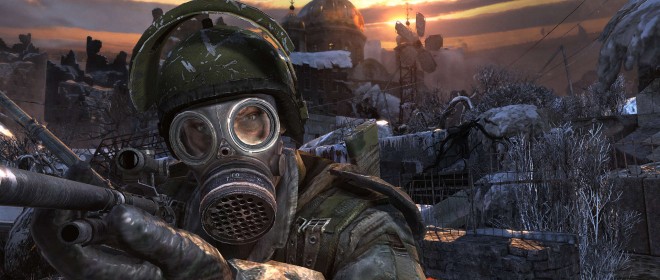
A gas mask is essential for venturing out of the metro and into the poisoned wasteland that was mother Russia. Gas masks require filters that need changed if you wish to survive any amount of time and how long you have on each filter can be monitored by a watch on your left wrist. Gas masks will also crack as you take damage meaning your vision can become impaired and will need replaced. Your flashlight becomes a vital piece of your armoury as you scavenge the various dark environments for further supplies. In order to keep it bright you must holster your weaponry and manually charge it with a universal charger, meaning that you’re vulnerable to attack from whatever enemies maybe lurking in the dark. Even your ammunition becomes vitally important for more reasons than simply self defence. In Metro 2033 ammo is currency and comes in many different varieties.
The most valuable ammo is pre war ammo it’s gold and shiny and worth a hell of a lot more than the metro manufactured dirty rounds. Obviously more scarce than the other ammo types pre war ammo isn’t just good for trading but also is very effective against any enemy its stopping power is unrivalled, it’s here your faced with a choice do you use your best ammo to tear down your enemies quickly and efficiently or save the ammo to spend and ensure you have enough kit to make it through to the next area. It’s a fantastic system that really requires players to think rather than simply point and pull the trigger at the bad guys.
Horror wise outside of dealing with human bandits and Nazis (yes Nazis) you’ll have to fend off some of the mutated monstrosities that now rule the top world and invade the last bastions of human territories below. The mutants range from giant mutated rats to nosalis that are mutated toothy creatures that hunt in packs with the sole aim of tearing your face off there are even winged demons that swoop down from above and attack you with great ferocity. All in all mutant foes are both terrifying looking and to deal with and each requires a strategy to take them down efficiently. Human enemies can be dealt with in a more traditional fashion although the opportunity to take down encampments stealth fully is a welcomed option as it helps the action feel fresh. Made with a rather modest budget the shooting mechanics could be tighter but when using the improvised weapons it does tie into the feel of the human resistance vulnerability in fact I didn’t feel comfortable in combat until I got my hands on the old faithful AK some 2 hours into the campaign.
Graphically the game stands up to any of its rivals and still looks impressive three years later, I am a believer in graphics don’t make games however the moody lighting and slick textures help breathe life into Metros world. Metro also delves into the realm of the super natural as ghosts of the past haunt the tunnels as they relive their gruesome past. Hearing the cries of children and screams of their mothers echo through the blood stained tunnels can send chills up the most hardened of player’s spines. Metro does help you along the way by introducing you to partners who have anterior motives to venture through the devastation. Sometimes in FPS’s the AI company provided is more of a hindrance but here each character is different and has a unique personality you’ll enjoy working with them and feel sad should they meet their demise. One of the games strongest elements are to do with the NPC’s a key attribute when trying to tell a meaningful story and I’m glad to say Metro achieves this undoubtedly.
Metro 2033 is available now on Steam and Xbox 360 for under £10 some retailers are even giving away free downloads with the Last Light demo, there has never been a better time to pick this cult classic up. Due to its competition from the genre and a relatively humble release Metro was missed by many and revered by few it’s only now its sequel is on the horizon have many gamers looked back and appreciated this hugely under rated title. Do yourself a favour and draw your blinds and turn the volume up its time to take a delve into the Metro
